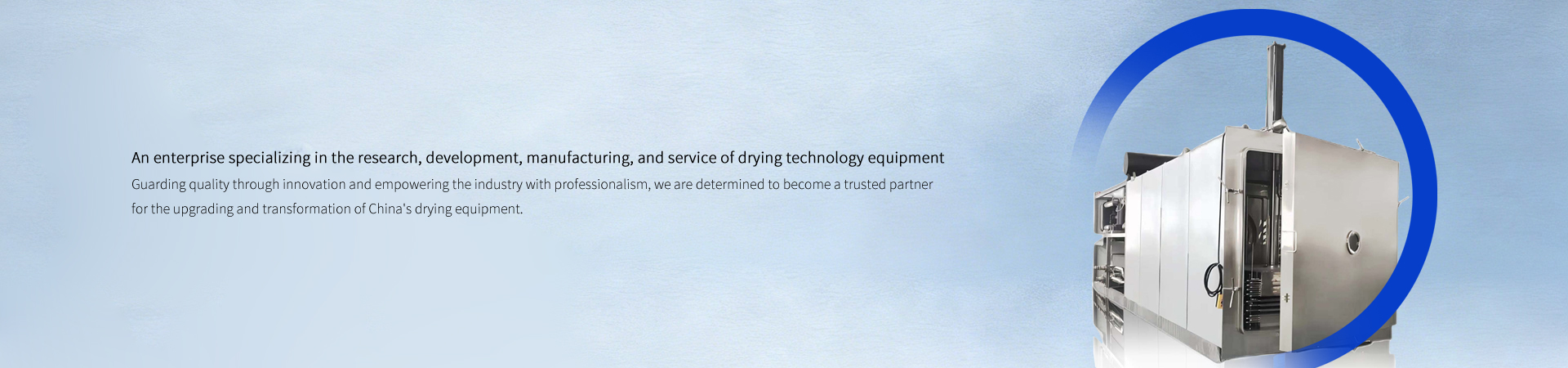
Freeze-drying technology is a special drying technology, and its principle is based on the three-phase change of water. The three phases of water (H2O) are solid, liquid, and vapor, which can coexist and transform into each other.
The key lies in the freezing process. When the aqueous solution is frozen (with a temperature decrease of 10~50℃ per minute), the crystals remain visible under a microscope; conversely, when frozen slowly (1℃/min), the formed crystals are observable. Coarse crystals leave relatively large gaps during sublimation, which can improve the efficiency of dry freezing. Fine crystals leave smaller gaps after sublimation, which hinders the sublimation of the next layer. Rapidly frozen products have fine particles, uniform appearance, large specific surface area, good porous material, and faster melting speed. Therefore, the moisture absorption of the finished product is relatively better.
Drugs are pre-frozen in two forms in a freeze dryer: one is to reduce the temperature of the product and the drying chamber simultaneously; the other is to reduce the temperature of the shelf in the drying chamber to around -40℃, and then place the product inside. The former method is equivalent to slow freezing, while the latter falls between freezing and slow freezing, and is therefore often chosen to combine high efficiency of dry freezing with product quality. The main disadvantage of this method is that when the product is placed in the chamber, water vapor in the air will quickly condense on the shelf. However, during the early stages of sublimation, if the shelf temperature rises rapidly, large-area sublimation may exceed the normal load of the condenser.
This situation is particularly evident in summer. The frozen part of the product is in a resting state. Work experience has confirmed that low temperature conditions are prone to occur, even though the product temperature has reached the eutectic point, the solution still cannot crystallize. In order to overcome the low temperature condition, the temperature at which the product freezes should be one degree below the eutectic point and maintained for a period of time to ensure that the product is completely frozen.
Next, we have the prerequisites and rate of sublimation. Sublimation can occur when the saturated vapor pressure of ice at a certain temperature exceeds the partial pressure of water vapor in the environment. The condenser, which has a lower temperature than the product, plays a crucial role in absorbing and capturing water vapor, which is essential for maintaining and preserving the sublimation process. The distance traveled by gas molecules during two consecutive collisions is called the vacuum permeability, which is inversely proportional to pressure. At atmospheric pressure, its value is not large, and the sublimated moisture is very prone to colliding with the gas and returning to the surface of the steam source, thus the sublimation rate is very slow.
With the working pressure reduced by 13.3 Pa, the vacuum permeability expands by 105 times, significantly accelerating the sublimation rate. The amount of water vapor escaping is very small, changing its layer and forming a directional steam flow. The mechanical pump in the freeze dryer plays the role of removing permanent gases to ensure the necessary low pressure for sublimation. Under natural pressure, 1g of water vapor occupies 1.25L, but at 13.3 Pa, it expands to 10,000L. It is impossible for an ordinary mechanical pump to remove such a large volume within the company's time limit. The condenser actually constitutes a specialized mechanical pump for collecting water vapor. The temperature of the product and condensation is generally -25℃ and -50℃. The saturated vapor pressure of ice at these temperatures is 63.3 Pa and 1.1 Pa respectively, thus forming a significant pressure difference between the sublimation surface and the condensation surface. If the partial pressure of non-condensable gases in the system is neglected at this time, it will promote the water vapor sublimated from the product to reach the surface of the condenser at a certain flow rate and form frost. The heat of sublimation of ice is approximately 2822 J/g. If no heat is provided during the entire sublimation process, then the product can only compensate for the heat of sublimation by reducing its temperature until it reaches equilibrium with the temperature of the condenser, at which point sublimation may cease. To maintain the temperature difference between sublimation and condensation, sufficient heat must be provided to the product.
Previous:What are the characteristics of the drying method of a spray dryer
Next:none!